
Showing posts with label Bakery. Show all posts
Showing posts with label Bakery. Show all posts
Saturday, April 30, 2011
Bottega Falai (Macarons) - April 27, 2011

Wednesday, April 20, 2011
Cannelle Patisserie - April 17, 2011
 “Consistent, Affordable and Exquisite” is the tripartite motto of Cannelle Patisserie, and which I whole-heartedly embrace and uphold. In order to live by such a motto, I am willing to sacrifice my personal property – a pair of new shoes – and bleed my own red blood – in the form of blisters – and start a revolution.
 Starting with affordability, Cannelle truly cares about the equality of his patrons; compared to the aptly named, blue-blooded Lady M, their cakes are equally and fraternally available to all comers, provided that if one is willing to venture out into the middle of nowhere – a strip mall.
Saturday, March 26, 2011

Wednesday, January 26, 2011
Shilla Bakery - December 11, 2010
Mochi bread
 Posthumously, I was informed of the Korean mochi bread craze that swept through the small island of Taiwan four years after its demise. To be exact, it was only the “craze” that died down, but not the mochi bread itself as it had quietly found a place among the staples on the shelves of Taiwanese bakeries. In a similar vein, another type of chewy bread became fashionable in Japan decades ago (and, for once, I was there to be on it real-time): Pão de Queijo – the cheesy balls from Brazil. The Asians are obsessed with the texture of this type of particular and distinct chewiness, expressed as QQ in Taiwanese or mochi mochi in Japanese. By the way, the Japanese version of mochi bead has existed for a quite while, which seems to differ from the Korean version in the choice of the key ingredient – the QQ or mochi mochi factor: The former primarily uses glutinous rice flour, while the latter tapioca starch.

Tuesday, January 18, 2011
Spong Cake Redux: New Kam Hing Coffee Shop - January 17, 2011

Tuesday, January 11, 2011
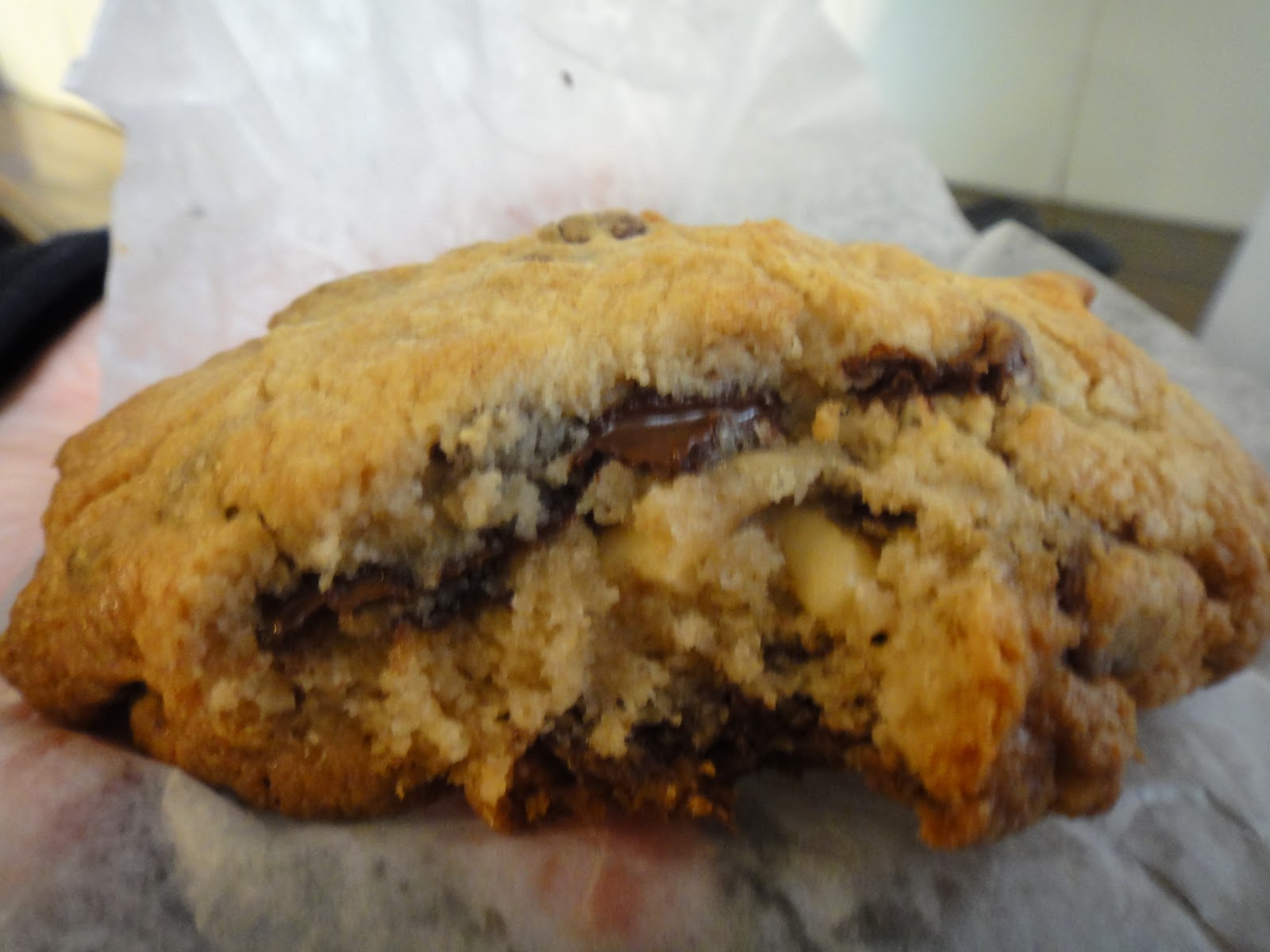
Levain Bakery - December 31, 2010
Sunday, January 2, 2011
Yuan Yang (Ho Won Bake Shoppe & XO Kitchen) - December 28, 2010
Sometimes things are more than they appear. – Shrek
The excitement from the sponge cakes at New Kam Hing had so stimulated the brain that my fellow crusader to Chinatown remembered having a terrific yuan yang in Chinatown: Yuan yang (literally meaning “Chinese ducks,” which are believed to stay as a pair throughout their lives) is a quintessentially Hong Kong drink – a blend of coffee and Hong Kong-style milk tea. Why Hong Kong? Because Hong Kong milk tea is made of seriously and lengthily boiled tea, against the better esteemed English method; furthermore, it is enhanced with condensed milk. My only trial of this potent caffeine elixir, yuan yang, was in the form of a tapioca milk tea, well, tapioca coffee and tea, and my memory of it is colored by a disdainful unpleasantness.
The excitement from the sponge cakes at New Kam Hing had so stimulated the brain that my fellow crusader to Chinatown remembered having a terrific yuan yang in Chinatown: Yuan yang (literally meaning “Chinese ducks,” which are believed to stay as a pair throughout their lives) is a quintessentially Hong Kong drink – a blend of coffee and Hong Kong-style milk tea. Why Hong Kong? Because Hong Kong milk tea is made of seriously and lengthily boiled tea, against the better esteemed English method; furthermore, it is enhanced with condensed milk. My only trial of this potent caffeine elixir, yuan yang, was in the form of a tapioca milk tea, well, tapioca coffee and tea, and my memory of it is colored by a disdainful unpleasantness.
Thursday, December 30, 2010
New Kam Hing Coffee Shop - December 28, 2010

Monday, November 8, 2010
Sigmund Pretzel Shop (Bryant Park) - November 6, 2010

Subscribe to:
Posts (Atom)