 |
| Beef Belly |
Showing posts with label Japanese. Show all posts
Showing posts with label Japanese. Show all posts
Monday, April 25, 2011
Takashi - April 22, 2011
What is the purpose of eating in a restaurant? It is to eat good food cooked by someone else: meaning, the food had better be superior to one’s own cooking, and the dishes should arrive at the table ready to be savored. Therefore, it is not merely annoying to be served bad food, but it also doubly insulting when I am served something that requires a lot of bottle shaking, to say the least. For this very reason, I have been perplexed by the raison d'être of yakiniku restaurants (Japanese Korean Barbecue), where the diners are expected to cook – grill - their own food – meat - (leaving aside, obviously, those side dishes) and serve themselves- wrap the meats in raw vegetables. Thus, as it appears, each diner is ultimately responsible for the outcome of their grilling skill. Where is the real chef?

Thursday, March 31, 2011
Kajitsu - March 26, 2011
According to the quintessential shojin ryoyi bible, Dogen’s “Tenzo Kyokun (FN1)” there are four cooking principles:
 1. Five cooking methods must be used: Raw, stewing (boiling), grilling, frying, steaming;
3. Fiver colors must be present: Red, white, green, yellow, black
4. Each ingredient must be utilized fully so that there will be no leftovers.
The corollary of the fourth principle is that in order to taste each ingredient, the seasoning must be kept to minimal and, therefore, stimulants must be avoided: e.g. garlic and nira (Chinese chives).
Shojin Ryori is the cornerstone of Japanese cuisine: Prior to the development of shojin ryori, the dishes were prepared in a rather laissez-faire way so that the diners had to season their own dishes. It was the teachings of Zen Buddhism that introduced the concept of appreciating food in all its stages - the creation, the service and the consumption – because everything one did was could be a part of the pursuit of understanding. Therefore, historically, the position of a tenzo, the cook, had enjoyed a high status in the hierarchy of a temple.
Saturday, March 19, 2011
Tori Shin – March 12, 2011
Is cooking an art or an expertise? If it is the latter, then one can become better at it by practice and experience; however, if it is the former, then no amount of practice and experience will not be sufficient because an art requires a stroke of ingenuity, does it not?
 Sometimes the line between art and expertise is blurry and art often encompasses expertise, which is natural since art is intrinsically a human act. One clear difference between art and expertise can be said that one can become an artist instantly, while one cannot be an expert without a certain passage of time. In Japanese, 芸術 (gei-jutsu) signifies art and 巧 (takumi) expertise. Gei, the first letter of the word, gei-jutsu, means a something that a person is able to do well and usually perform in front of an audience – e.g. dance, kabuki (one type of traditional Japanese theater), musical instruments – as in gei-sha (originally meaning a performer). Takumi, on the other hand, refers to a skillfulness that connotes a long time of hard study and practice. Alternatively, takumi can be written as (匠), which was used to mean a professional in the field of primarily carpentry, masonry and smithy. Since gei also requires an apprenticeship, it follows that all forms of “art” are “skills” in Japanese. Similarly, apprenticeships also existed in Europe – e.g. Da Vince apprenticed in the workshop of Verrocchio. Therefore, it is perhaps simply the word, “art” and the profession, “artist” that have been magnified and intensified, often out of proportion, by our relatively newly found liberation or consolidated rights in the last two hundred years: Casting off humility and perspective, art sometimes serves as a convenient excuse for debauchery and delusion.
 Sometimes the line between art and expertise is blurry and art often encompasses expertise, which is natural since art is intrinsically a human act. One clear difference between art and expertise can be said that one can become an artist instantly, while one cannot be an expert without a certain passage of time. In Japanese, 芸術 (gei-jutsu) signifies art and 巧 (takumi) expertise. Gei, the first letter of the word, gei-jutsu, means a something that a person is able to do well and usually perform in front of an audience – e.g. dance, kabuki (one type of traditional Japanese theater), musical instruments – as in gei-sha (originally meaning a performer). Takumi, on the other hand, refers to a skillfulness that connotes a long time of hard study and practice. Alternatively, takumi can be written as (匠), which was used to mean a professional in the field of primarily carpentry, masonry and smithy. Since gei also requires an apprenticeship, it follows that all forms of “art” are “skills” in Japanese. Similarly, apprenticeships also existed in Europe – e.g. Da Vince apprenticed in the workshop of Verrocchio. Therefore, it is perhaps simply the word, “art” and the profession, “artist” that have been magnified and intensified, often out of proportion, by our relatively newly found liberation or consolidated rights in the last two hundred years: Casting off humility and perspective, art sometimes serves as a convenient excuse for debauchery and delusion.
 While I can certainly envision cooking as an art, however, yakitori seems to be more a form of takumi.
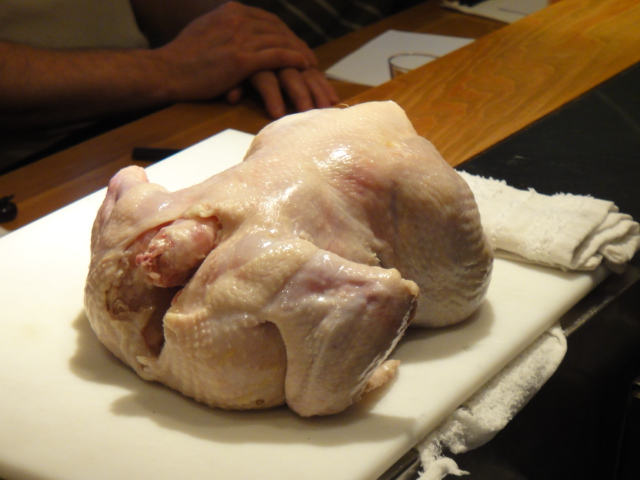
Tori Shin (Demonstration) – March 12, 2011
Friday, February 11, 2011
Castella from Ukeian (烏鶏庵) – February 6, 2011

Friday, January 21, 2011
Ushiwakamaru - January 19, 2011
The seven-year itch (and The Seven Year Itch), Seven Years in Tibet… Seven years seem like a good benchmark for understanding and revaluating a relationship and the object and the subject of such relationship. Perhaps seven years are a long enough time to burrow deeply into it, and yet, short of being too long so that it will be too late to extricate yourself. It has been seven years since, and several lives ago now, when I was first introduced to Ushiwakamaru.

When I first crossed the threshold of Ushiwkamaru, most of the hikarimono – meaning “shining fish” for the bluish glare of the skin (basically fish noted for containing much omega-3 fatty acid) – was beyond my narrow reach. In the early days of my gourmand life, tuna was gross and sea urchin was nothing more than custard with soy sauce.* Is it better to not have known so that you would not know what you are missing? Or is it worse not being able to have what you have once had? Had I never known good sushi, I would still have been content with Planet Sushi and my contentment would have been more often. However, that is contentment, not happiness. Considering the intensity of the pleasure derived from true excellence, I think chewing my lips in remembrance is still far more meaningful than living a life of ignorance.
*This is the most famous fake recipe of all times.

When I first crossed the threshold of Ushiwkamaru, most of the hikarimono – meaning “shining fish” for the bluish glare of the skin (basically fish noted for containing much omega-3 fatty acid) – was beyond my narrow reach. In the early days of my gourmand life, tuna was gross and sea urchin was nothing more than custard with soy sauce.* Is it better to not have known so that you would not know what you are missing? Or is it worse not being able to have what you have once had? Had I never known good sushi, I would still have been content with Planet Sushi and my contentment would have been more often. However, that is contentment, not happiness. Considering the intensity of the pleasure derived from true excellence, I think chewing my lips in remembrance is still far more meaningful than living a life of ignorance.
*This is the most famous fake recipe of all times.
Subscribe to:
Posts (Atom)