 It was a testament of my undying and greedy love that brought me across two rivers and two bridges, after a
Showing posts with label Taiwanese. Show all posts
Showing posts with label Taiwanese. Show all posts
Wednesday, May 4, 2011
Main Street Imperial Taiwanese Gourmet / C&L Imperial, Inc. (北港) - April 30, 2011
It was a testament of my undying and greedy love that brought me across two rivers and two bridges, after a 
Monday, April 4, 2011
C&L Imperial, Inc. (北港) - April 2, 2011
 Agitation was edging toward turmoil as I stared at the menu on the wall; each dish handwritten and occupying its own rectangle of red paper, without, needless to say, any illumination or illustration as to the mysteries of Chef Lin’s specialties: The problem was how to contain my rampant enthusiasm into a humane and moral number of orders. However, a yellow-clad, smiling Maitreya*-incarnate, in the person of Chef Lin, arrived to save me from my self-induced and self-indulgent personal hell of greed, who enlightened me as to his expertise in quick sautéing; then benevolently tapped his belly and confided that he really should not eat any more of his spare ribs, well, not so much at any rate. After a summary consultation with my own belly for the most likely consequences, the spare ribs were duly ordered, along with an array of other worldly desires that would certainly prevent me from reaching nirvana anytime soon.
 *Very popular in Taiwan, he is usually depicted as a widely grinning Buddha with a large pot belly and dangling ear-lobes.
Thursday, March 10, 2011
C&L Imperial, Inc. (北港) - March 8, 2011
Taiwanese and other various regional Chinese cuisines of the great Middle Kingdom seem to have all agreed on one thing: They had left behind their culinary heritage back in the homeland in order to embrace the harsh new world of McDonald’s. Or the truly talented chefs have never left. Flushing has fared better than Chinatown in Manhattan, thanks to the royal Taiwanese community, albeit not as populous as little Taiwan over in California.
My fellow gastronomic crusader, the one and only with a proven track record, had wanted to drag me out to Flushing for C&L since last year, largely hindered by the unaccommodating weather condition in New York. C&L Imperial, Inc., or 北港 (named after a town in Taiwan; no, no relation to the “imperial”), is located across from the much noted Yeh’s Bakery(紅葉), which I had tried in the past by mistakenly walking from central Flushing on a summer. However, it was reassuring that the restaurant was 1) in an alternate and newer Taiwanese section away from the main streets of Flushing, and 2) yet able to consistently draw in a large crowd.

My fellow gastronomic crusader, the one and only with a proven track record, had wanted to drag me out to Flushing for C&L since last year, largely hindered by the unaccommodating weather condition in New York. C&L Imperial, Inc., or 北港 (named after a town in Taiwan; no, no relation to the “imperial”), is located across from the much noted Yeh’s Bakery(紅葉), which I had tried in the past by mistakenly walking from central Flushing on a summer. However, it was reassuring that the restaurant was 1) in an alternate and newer Taiwanese section away from the main streets of Flushing, and 2) yet able to consistently draw in a large crowd.

Saturday, November 13, 2010
台南芋粿 (Tainan style taro cake) - November 13, 2010
 |
| Shaved Ice Stand Selling Taro Balls |
Tuesday, October 19, 2010
Gu-Shine Taiwanese Restaurant - October 17, 2010
My dining experience in Taiwan has been somewhat curtailed by none less than my own insatiable and uncontrollable appetite for street food; thus, I cannot claim much knowledge in Taiwanese dishes served in restaurants. While I am in Taiwan, I am continuously attracted, distracted and tempted by the aroma and sights from the numerous, ubiquitous and inventive street vendors that I never manage to get myself into a four-walled establishment with an air conditioner; furthermore, I am hampered by the fact that my mouth and stomach are constantly filled and re-filled without interruption from old favorites and new finds on the street.
 |
| Sautéed Stinky Tofu |
Thursday, August 19, 2010
Vegan and vegetarian Cuisine in Taiwan (Part 4 of 4)
My last humble learning experience was at 玥飲軒 (yue-ying-shuen), which was actually a tea salon. We originally wanted to have tea here, but was just too intrigued by their culinary offerings: Milk tea hot pot, 客家 (ke-jia, one of the diverse Taiwanese ethnicities) 擂茶 (this ke-jia specialty is made of about a dozen different ingredients – barley, sesame, toasted rice, various beans – all ground together in a bowl with green tea, quite restorative and healthy, not to mention delicious) hot pot and vegetarian lion’s head (a.k.a. meat balls). So, we came back for dinner the next day to try out these very dishes.
The milk tea hot pot turned out to be the famous Taiwanese tapioca milk tea hot pot with black tapioca pearls. It was not sweet, don’t worry, and it was not bad, really, just totally befuddling. The fried dough, yo-tiao, dipped in the milk tea was actually delicious. But as the pot cooled, the soup (did I mention the importance of the soup base?) really turned into tapioca milk tea and it was just, well, weird. It is worth a try, once in a lifetime, you know, I must say.

Curried lion’s head was the best dish of the night in terms of tastes. Its curry sauce was complex with spice and yet mild and creamy with coconut milk and just went down into my stomach really fast with the tea rice (just rice cooked with tea). The “meat balls” also had a perfect tenderness and complemented the curry sauce. Vegetarian or vegan or whatnot, it was a delicious dish.

One word about service, again: The service was slow (the boy) and sulky (the girl). They say you get more energy, animalistic energy anyway, from eating meat. So, is the slow service due to the lack of meat? However, this is a tea salon and they have other omnivore dishes…so, this theory fails. On the other hand, what about sulkiness? Tea is supposed to calm the mind and give you time for introspection. Perhaps the girl needs to sit herself down and brew a pot of tea, huh? The good news is that they are looking to hire some new people, so you may have better luck than we did.
Restaurant Info:
玥飲軒: 台北巿溫洲街80號 (02)83693963
http://www.yys95.netfirms.com/
The milk tea hot pot turned out to be the famous Taiwanese tapioca milk tea hot pot with black tapioca pearls. It was not sweet, don’t worry, and it was not bad, really, just totally befuddling. The fried dough, yo-tiao, dipped in the milk tea was actually delicious. But as the pot cooled, the soup (did I mention the importance of the soup base?) really turned into tapioca milk tea and it was just, well, weird. It is worth a try, once in a lifetime, you know, I must say.
Tapioca Milk Tea Hot Pot.jpg)
客家擂茶hot pot, compared to the tapioca milk tea, was just uninteresting: The seeds and beans of the客家擂added depth to the soup, so it was more like soy milk hot pot than anything else. Therefore, even as it cooled, I had no problem finishing this one..jpg)
客家擂茶 Hot Pot

Curried lion’s head was the best dish of the night in terms of tastes. Its curry sauce was complex with spice and yet mild and creamy with coconut milk and just went down into my stomach really fast with the tea rice (just rice cooked with tea). The “meat balls” also had a perfect tenderness and complemented the curry sauce. Vegetarian or vegan or whatnot, it was a delicious dish.
Curried Lion’s Head

One word about service, again: The service was slow (the boy) and sulky (the girl). They say you get more energy, animalistic energy anyway, from eating meat. So, is the slow service due to the lack of meat? However, this is a tea salon and they have other omnivore dishes…so, this theory fails. On the other hand, what about sulkiness? Tea is supposed to calm the mind and give you time for introspection. Perhaps the girl needs to sit herself down and brew a pot of tea, huh? The good news is that they are looking to hire some new people, so you may have better luck than we did.
Restaurant Info:
玥飲軒: 台北巿溫洲街80號 (02)83693963
http://www.yys95.netfirms.com/
Wednesday, August 18, 2010
Vegan and vegetarian Cuisine in Taiwan (Part 3 of 4)
My rematch with vegan food was at the food court of a department store at a place called可楽鍋 (ke-le-guo). For those who understand Chinese, the word, “可楽,” must have already sent a red, flashing warning sign (or have at least awaken a few readers): It means cola, yes, as in Coca-Cola. Regrettably, this review is not about the fascinating cola hot pot in which the cola is supposed to soften the meat, but about the “meat” in one of their more conventional tomato-basil hot pot (the place actually features international hot pots – other varieties include Thai curry, which we also tried, and German sauerkraut, which we did not try). Thealleged “meat” were supposedly made of the stalks of shiitake mushrooms. How the beguiling fungus metamorphosizes into “meat,” I do not know. What I know is that it was “meat” and it was a stringy, healthy, lean red meat. Just see for yourself (if not taste for yourself): It is brown and it has the fiber and it has the taste.

 No, I am not kidding you: These are the real pictures. You want more proof? See if these look like short ribs to you! I can tell you that these were softer and juicier than the previous “meat,” just like some good, tender short ribs… Crazy country, is Taiwan, I am telling you…
 My Quest in Taiwan will continue tomorrow… Stay tuned.
Restaurant Info:
可楽鍋: Located in the Dayeh Takashimaya. http://www.dayeh-takashimaya.com.tw/food/food.html

 No, I am not kidding you: These are the real pictures. You want more proof? See if these look like short ribs to you! I can tell you that these were softer and juicier than the previous “meat,” just like some good, tender short ribs… Crazy country, is Taiwan, I am telling you…
Restaurant Info:
可楽鍋: Located in the Dayeh Takashimaya. http://www.dayeh-takashimaya.com.tw/food/food.html
Tuesday, August 17, 2010
Vegan and vegetarian Cuisine in Taiwan (Part 2 of 4)
My omnivore self was put to test for the second time at 衆流素食 (zhong-liou-xu-shi). We ordered a kind of cactus with passion fruit sauce, squid sashimi, braised fish with 樹子 (xu-tsu, type of indigenous fruits, which are bit like the leftover soybean after making soy sauce, which is used in many cooking – yes, I know you have no idea what I am talking about; this blog is not for the uninitiated), stewed dried bamboo shoot with 香椿 (xian-chuang), a crazy Taiwanese herb which I will explain more below, soup dumplings with 糸瓜 (si-gua, a type of melon) and sautéed vegetables. Now, we are talking about serious and quite inventive vegan cuisine (and I will skip the more mundane items, such as the sautéed vegetables), and let me start from the first wondrous eye-opener: The squid sashimi.
Squid Sashimi in a Melon Bowl and Cactus with Passion Fruit Sauce

The squid was made of konnyaku, supposedly. It had the perfect texture of raw squid, but the wonder did not cease here. This sashimi of allegedly fake squid had a squid taste. It really did. You don’t believe me? OK, I am willing to consider that maybe I was just shocked into believing by the supreme reality of the appearance and texture. However, my mouth assures you that it had a fishy taste.
The second wonder was the stewed, dried bamboo shoots with 香椿.
The third wonder of the day was the braised fish with樹子.

Very simply put, it was “fish.” Do I need to say more? The “fish” was probably made of taro (I am new to this game of guessing what my “fish” is made of, OK?) and it had seaweed wrapped around each slice of the “fish fillet.” My amateur educated guess would be that this piece of seaweed gives the “fish” its “fishiness, although this does not explain the squid, sorry, the fake squid. Once this “fish” was stewed with this indigenous Taiwanese fruit (no, it is not fishy fruit; one lamby herb is enough for one country, no?), which has a very strong flavor and umami (this word has got to be standard culinary word by now, right?), you have a beautiful braised fish. Do not frown until you have eaten it: the taro even gave it the fiberish texture of fish, if you know what I mean?
One word on the service: Our waitress, looking more porcine than vegan, together with a manager-looking woman with a heart not quite Buddhist, hurried us through the meal since the kitchen was closing swiftly at 8:45PM. It is healthy to be a vegan, no?
My Quest in Taiwan will continue tomorrow… Stay tuned.
Restaurant Info:
衆流素食: 台北市龍江路102號1樓 (02-2516-5757 )
http://www.wewi.com.tw/chongliu/

The squid was made of konnyaku, supposedly. It had the perfect texture of raw squid, but the wonder did not cease here. This sashimi of allegedly fake squid had a squid taste. It really did. You don’t believe me? OK, I am willing to consider that maybe I was just shocked into believing by the supreme reality of the appearance and texture. However, my mouth assures you that it had a fishy taste.
The second wonder was the stewed, dried bamboo shoots with 香椿.
Stewed Dried Bamboo Shoot with 香椿

I took a scoop and put it in my mouth and I was totally dumbfounded: Why do I taste lamb? This herb, 香椿, confirmed by my vegetarian host so that I was not high on something else as to mistake its taste, had a lamby taste! The reason that I actually disliked the dish was because it was too lamby… believe it or not. My host told me that the first time she tried it in a fried rice, her rice was so lamby and gamey that she almost suspected that the pan used to fry the rice was actually used to cook lamb before her dish (but she were dining in a vegan restaurant). So, in Taiwan, a.k.a. “the treasure island”, you can grow herbs which taste just like lamb (and a very lamby lamb at that). Crazy island…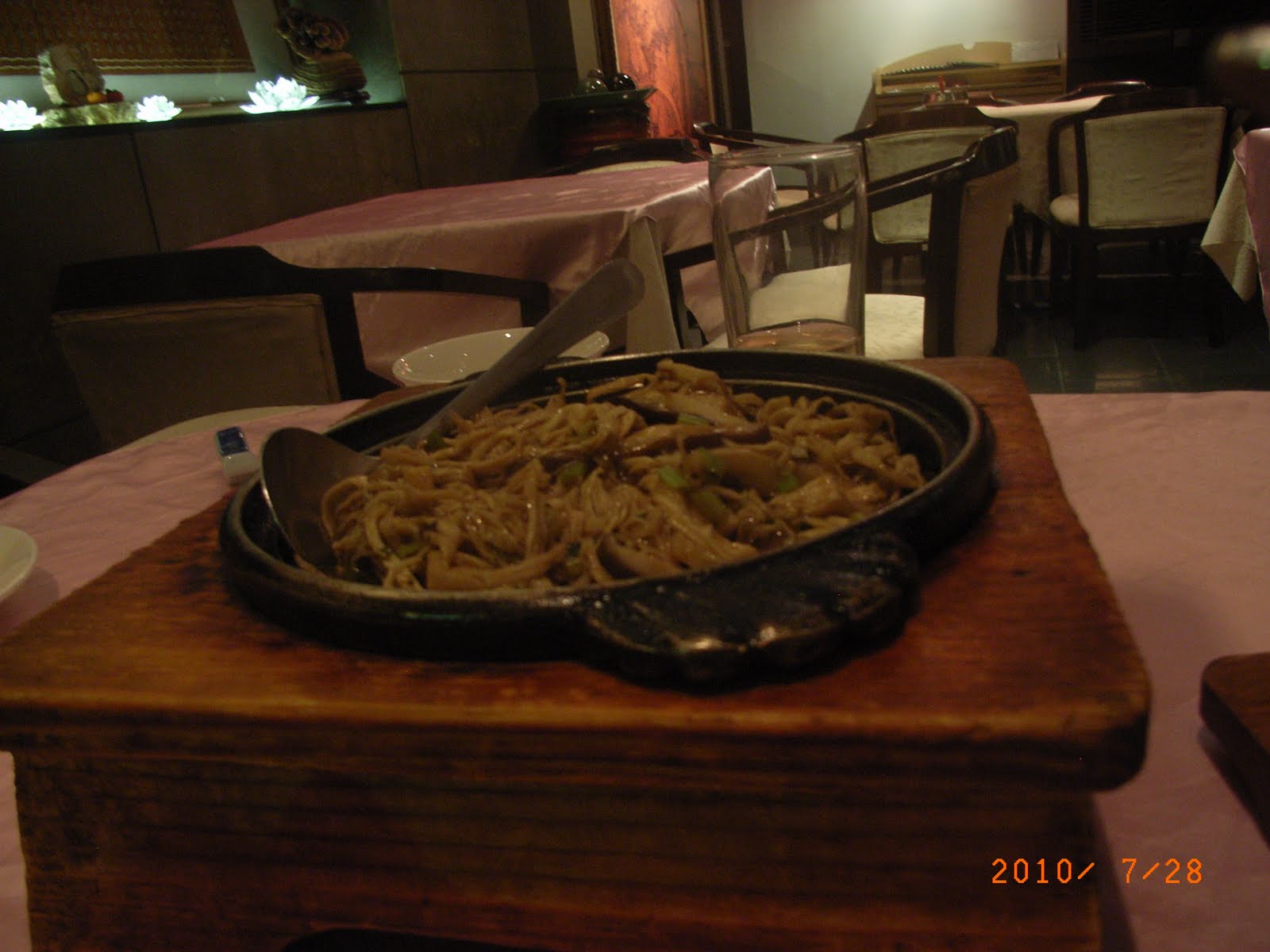
The third wonder of the day was the braised fish with樹子.

Very simply put, it was “fish.” Do I need to say more? The “fish” was probably made of taro (I am new to this game of guessing what my “fish” is made of, OK?) and it had seaweed wrapped around each slice of the “fish fillet.” My amateur educated guess would be that this piece of seaweed gives the “fish” its “fishiness, although this does not explain the squid, sorry, the fake squid. Once this “fish” was stewed with this indigenous Taiwanese fruit (no, it is not fishy fruit; one lamby herb is enough for one country, no?), which has a very strong flavor and umami (this word has got to be standard culinary word by now, right?), you have a beautiful braised fish. Do not frown until you have eaten it: the taro even gave it the fiberish texture of fish, if you know what I mean?
One word on the service: Our waitress, looking more porcine than vegan, together with a manager-looking woman with a heart not quite Buddhist, hurried us through the meal since the kitchen was closing swiftly at 8:45PM. It is healthy to be a vegan, no?
My Quest in Taiwan will continue tomorrow… Stay tuned.
Restaurant Info:
衆流素食: 台北市龍江路102號1樓 (02-2516-5757 )
http://www.wewi.com.tw/chongliu/
Monday, August 16, 2010
Vegan and Vegetarian Cuisine in Taiwan (Part 1 of 4)
As a die-hard omnivore, I have an inbred suspicion toward the word, “vegan.” Although my brain understands that some of my favorite foods can be quite easily vegan – chocolates, baguette, salads… Well, I have to admit that my imagination dries up there: if I started counting mango, papaya, dragon fruits, etc., it would be kind of cheating, wouldn’t it? However, what little did I know about the world of Taiwanese veganism! I am not talking about soy milk, tapioca pearls, grass jelly, taro pearls, sweet soft tofu and the endless variations of shaved ice, although on which I will happily substitute for three months, or longer, if you will allow me to include dairy products so that I can have my naisu bread (奶酥麺包 – an addictive concoction of butter and powdered milk, used as filling of bread, such as “the bomb,” in its most glorious form) as well. I digress. Here, I am talking about real and actual dishes, cuisines, creations or whatever you may call them, some of which are more real than Madame Tussauds’ wax figures (well, they are tacky anyway).
My first cognizant encounter of vegetarian food in Taiwan was at 佰菇園 (baiguyuen – a garden of hundred mushrooms – but please do not rely on my pinying): I went there to humor my vegetarian hosts who were graceful enough to suffer my free board for two weeks and also to bolster my vegetable intake as my body was getting worried to live on mostly carbohydrate. This restaurant was a part of a hot pot chain focused on literally a hundred kinds of mushrooms domestic to Taiwan and foreign. Of course, I had to pick the most enticing mushroom on the menu – the monkey head – among other kinds which my memory just could not retain. The key to a good hot pot, if you do not know, is the soup base: The ingredients otherwise can be mediocre (of course, the better the ingredients, the better the end product, what do you expect?) but the hot pot will still come out fine. Their soup was made of Chinese herbs and mushrooms, yet it did not have the typical medicinal and bitter taste of such herbs; in fact, it was quite delicious. Into this soup, we dumped in mushrooms, vegetables, konnyaku (a kind of jelly-like food, with no calories but lots of fiber, made from an indigenous root in Japan), tofu, and various vegan balls.* These vegan balls would have fooled me if we had not ordered a vegetarian course. Nevertheless, the hurdle of this first round seemed too low because, after all, we were having a hot pot of mushrooms, not exactly a full course vegan extravaganza. I have to mention, just in case you are vegan, the hot-pot vegetarian course comes with hand-made, freshly steamed mini buns, to be dipped into sweet, condensed milk. I am sorry if you are truly vegan because it was good. On the other hand, this is cheating, isn’t it?: How can anything to do with condensed milk be bad?
*A common ingredient in a hot pot is “fish cakes,” as translated on restaurant menus in the U.S. I think this translation is erroneous. These are not cakes: These are more correctly translated as “balls.” The main ingredient of these balls is usually fish (although sometimes shrimp), pounded into a paste and rolled into balls. Therefore, as you now know, they have nothing to do with “cakes.”
My Quest in Taiwan will continue tomorrow... Stay tuned.
Restaurant Info:
佰菇園: 台北市仁愛路4段71巷17號 (02-8773-3160)
My first cognizant encounter of vegetarian food in Taiwan was at 佰菇園 (baiguyuen – a garden of hundred mushrooms – but please do not rely on my pinying): I went there to humor my vegetarian hosts who were graceful enough to suffer my free board for two weeks and also to bolster my vegetable intake as my body was getting worried to live on mostly carbohydrate. This restaurant was a part of a hot pot chain focused on literally a hundred kinds of mushrooms domestic to Taiwan and foreign. Of course, I had to pick the most enticing mushroom on the menu – the monkey head – among other kinds which my memory just could not retain. The key to a good hot pot, if you do not know, is the soup base: The ingredients otherwise can be mediocre (of course, the better the ingredients, the better the end product, what do you expect?) but the hot pot will still come out fine. Their soup was made of Chinese herbs and mushrooms, yet it did not have the typical medicinal and bitter taste of such herbs; in fact, it was quite delicious. Into this soup, we dumped in mushrooms, vegetables, konnyaku (a kind of jelly-like food, with no calories but lots of fiber, made from an indigenous root in Japan), tofu, and various vegan balls.* These vegan balls would have fooled me if we had not ordered a vegetarian course. Nevertheless, the hurdle of this first round seemed too low because, after all, we were having a hot pot of mushrooms, not exactly a full course vegan extravaganza. I have to mention, just in case you are vegan, the hot-pot vegetarian course comes with hand-made, freshly steamed mini buns, to be dipped into sweet, condensed milk. I am sorry if you are truly vegan because it was good. On the other hand, this is cheating, isn’t it?: How can anything to do with condensed milk be bad?
*A common ingredient in a hot pot is “fish cakes,” as translated on restaurant menus in the U.S. I think this translation is erroneous. These are not cakes: These are more correctly translated as “balls.” The main ingredient of these balls is usually fish (although sometimes shrimp), pounded into a paste and rolled into balls. Therefore, as you now know, they have nothing to do with “cakes.”
My Quest in Taiwan will continue tomorrow... Stay tuned.
Restaurant Info:
佰菇園: 台北市仁愛路4段71巷17號 (02-8773-3160)
Subscribe to:
Posts (Atom)